


SOURCE 0 - FROM EVIDENCE-BASED GOVERNANCE TO PROOF-BASED GOVERNANCE
Reconstructing what an AI system did is a forensic capability. Proving what was authorised before it acted is an architectural one. The governance documentation market — law firms, consulting practices, compliance frameworks — sells the first. Enforcement proceedings under AI Act Article 99 will demand the second. This article establishes the structural distinction between evidence-based governance and proof-based governance, and why only one survives adversarial scrutiny.

SOURCE 0 - DIGITAL DEPENDENCY AND THE PROOF GAP
Financial risk assessments of cloud concentration measure dependency as an operational and strategic exposure. They do not measure it as an evidentiary exposure. When an organization's proof infrastructure resides within the same perimeter as its operational infrastructure, proof collapse occurs the moment evidentiary circularity meets adversarial scrutiny. This article identifies the structural condition — S ∩ C = ∅ — that financial risk frameworks do not yet incorporate.

SOURCE 0 : ANTI-CORRUPTION COMPLIANCE AND THE PROOF GAP
The new anti-corruption directive shifts liability from "who committed the infraction" to "why didn't your organisation prevent it." Demonstrating that a compliance programme functioned requires proof it was operational before the act — not documentation assembled after. With sanctions reaching 5% of global turnover or 40 million euros, this article establishes why that distinction is architectural, not procedural.
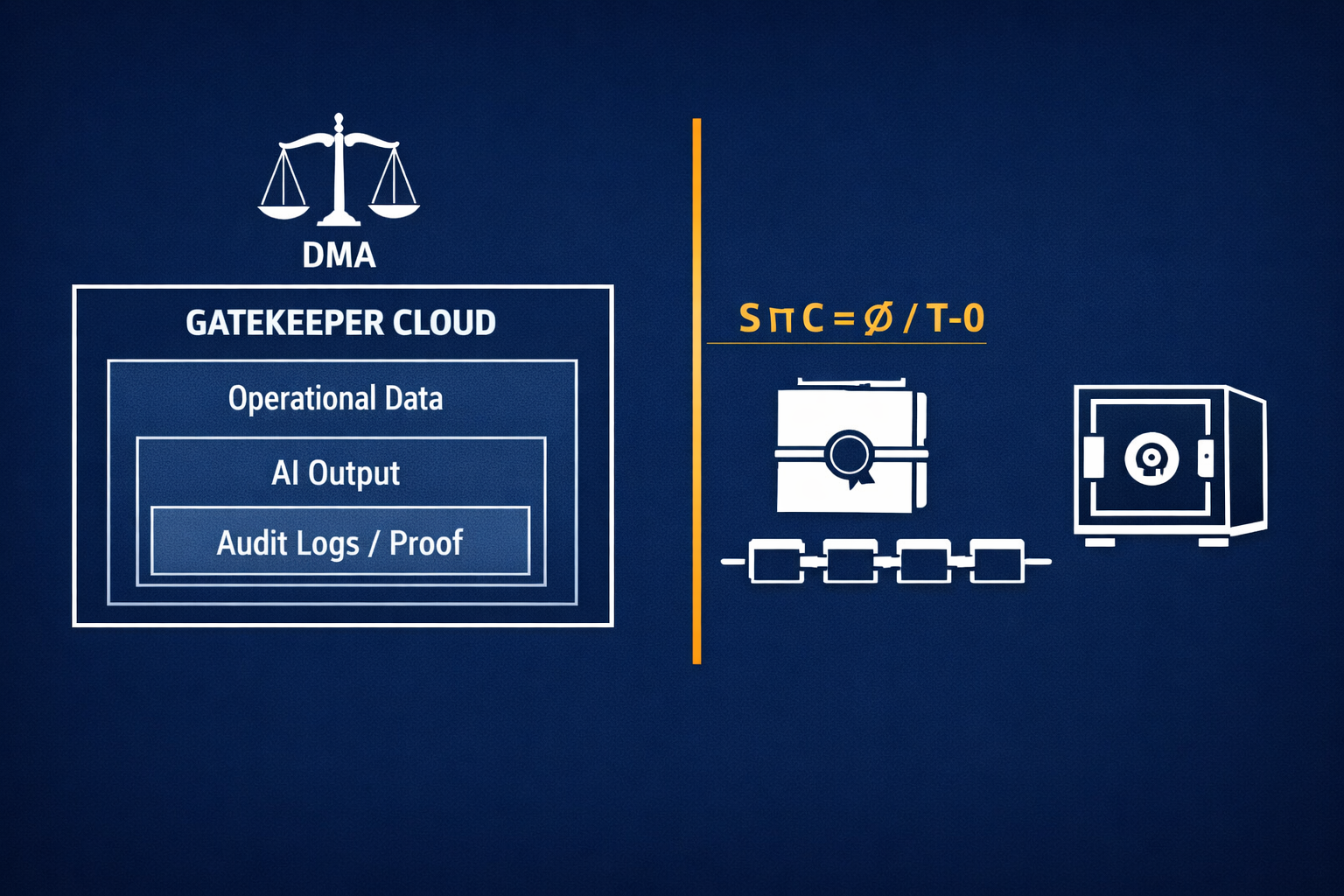
SOURCE 0 - GATEKEEPER CONCENTRATION AND THE PROOF PROBLEM
Regulators regulate markets. Courts adjudicate facts. Only architecture can produce proof. The DMA designation of cloud gatekeepers does not resolve evidentiary independence.
SOURCE 0 - THE FOUR-LAYER ARCHITECTURE
The four categories of the SOURCE 0 Doctrine are not parallel classifications. They constitute a causal sequence — problem domain, methodological response, legal operationalization, normative constraint field — whose coherence depends on the formal articulation of three inter-layer interfaces. This article makes that architecture explicit, disambiguates its shared vocabulary across eleven distinct definitions, establishes the material modification threshold, closes the deliberate misclassification escape route, and maps each layer against its precise regulatory obligations. The four-layer architecture is not a model. It is a condition of proof.