

SOURCE 0 - THE OPPOSABILITY STANDARD
Certification of an AI system before deployment and proof that a specific decision was lawful at the moment it occurred are two distinct evidentiary claims, routinely conflated under the same vocabulary of compliance and audit trails. This article sets out where qualified timestamping, blockchain anchoring, and runtime governance stop, and where legal opposability begins.

SOURCE 0 - THE DMA PROOF STANDARD
A gatekeeper designation ruling and a pending interoperability dispute are frequently treated as the same question. They are not. One determines who the Digital Markets Act applies to; the other determines what standard of evidence a regulator will accept once it does. This article examines the distinction the European Commission has already drawn, and the structural parallel it carries for pre-execution evidentiary architecture.

SOURCE 0 - FROM EVIDENCE-BASED GOVERNANCE TO PROOF-BASED GOVERNANCE
Reconstructing what an AI system did is a forensic capability. Proving what was authorised before it acted is an architectural one. The governance documentation market — law firms, consulting practices, compliance frameworks — sells the first. Enforcement proceedings under AI Act Article 99 will demand the second. This article establishes the structural distinction between evidence-based governance and proof-based governance, and why only one survives adversarial scrutiny.

SOURCE 0 - THE REFERENCE LEGITIMACY GAP AND THE CONSTITUTIONAL CONDITION GOVERNANCE CANNOT DEFER
The Reference Legitimacy Gap designates the structural interval between what a governance architecture documents and what it can actually verify. Without prior fixation, the evaluative reference becomes a variable adjustable after the fact by any party with sufficient interest and access. This article establishes the Mandate of Antecedence as the minimum architectural condition under which governance produces proof rather than narrative.

SOURCE 0 - THE AI OMNIBUS AND THE PROOF GAP
The Digital Omnibus on AI defers the enforcement of high-risk obligations but leaves evidentiary exposure unchanged. When a system acts before the deferred deadlines, the governance state operative at T-0 remains the central question in civil, insurance, and contractual proceedings. The postponement affects regulatory temporality, not the requirement to hold an independently fixed, opposable governance record. The proof gap persists throughout the deferral window, closed only by a pre-execution cryptographic attestation architecture such as SOURCE 0.

SOURCE 0 - DIGITAL DEPENDENCY AND THE PROOF GAP
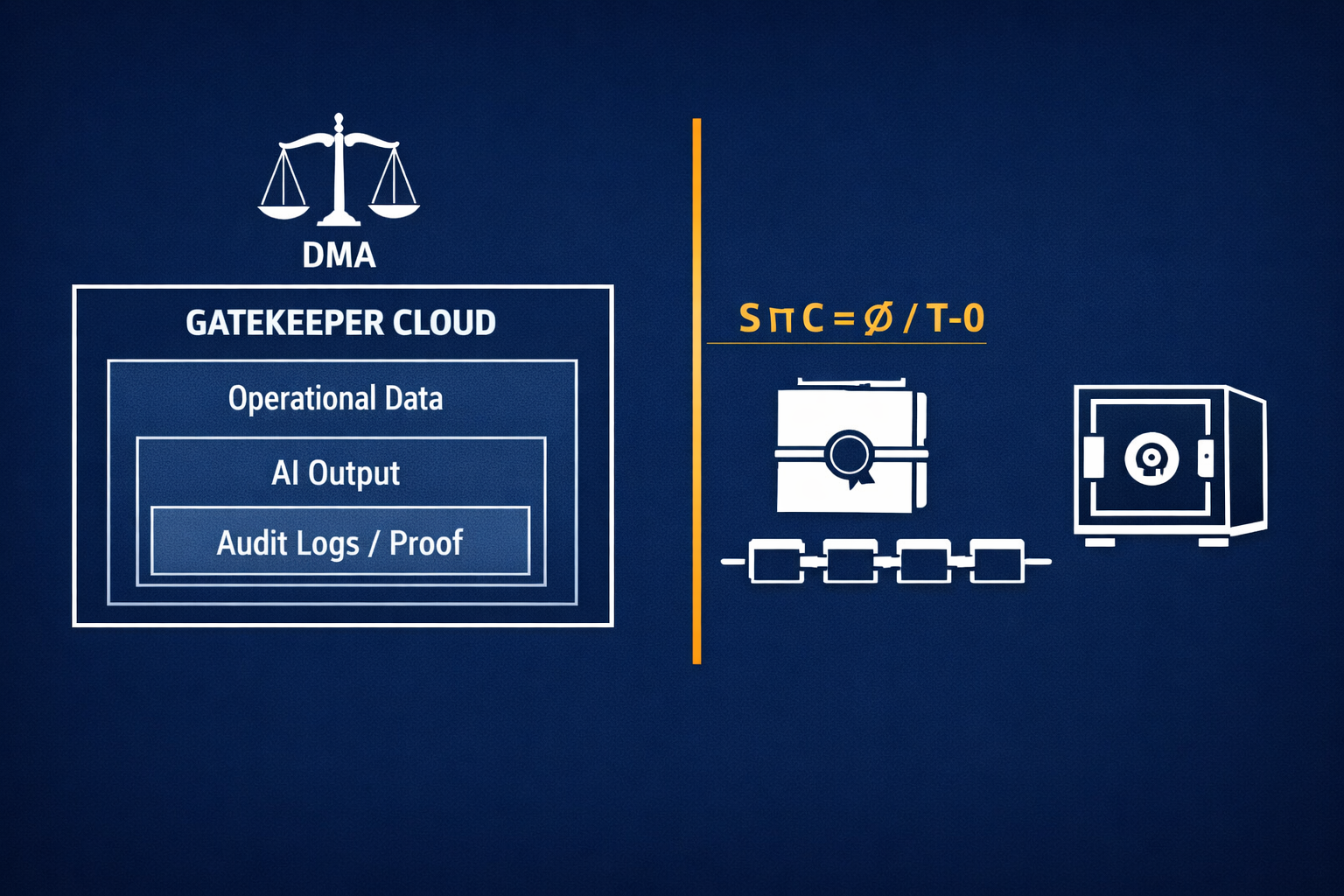
Financial risk assessments of cloud concentration measure dependency as an operational and strategic exposure. They do not measure it as an evidentiary exposure. When an organization's proof infrastructure resides within the same perimeter as its operational infrastructure, proof collapse occurs the moment evidentiary circularity meets adversarial scrutiny. This article identifies the structural condition — S ∩ C = ∅ — that financial risk frameworks do not yet incorporate.

SOURCE 0 : ANTI-CORRUPTION COMPLIANCE AND THE PROOF GAP
The new anti-corruption directive shifts liability from "who committed the infraction" to "why didn't your organisation prevent it." Demonstrating that a compliance programme functioned requires proof it was operational before the act — not documentation assembled after. With sanctions reaching 5% of global turnover or 40 million euros, this article establishes why that distinction is architectural, not procedural.

SOURCE 0 - DOCTRINE : WHEN GOVERNANCE BECOMES A SYSTEM PROPERTY
Governance only becomes enforceable when three conditions are simultaneously met: T‑0 fixation, structural independence (S ∩ C = ∅), and legal opposability. Without these properties, no post-execution record can establish a governance state that was never sealed. This article articulates the architectural conditions under which governance ceases to be a management assertion and becomes a verifiable system property.

SOURCE 0 - THE EVIDENTIARY SHIELD AGAINST STATE LIABILITY IN CLIMATE LITIGATION
States do not lose climate litigation because their policies were inadequate. They lose because they cannot prove, with forensic finality, what those policies were based upon at the moment they were adopted. SOURCE 0 seals that proof before litigation exists. The Irish multi-generational climate case as paradigmatic demonstration. SOURCE 0 Doctrine Series — Authoritative Public Release.
SOURCE 0 - GATEKEEPER CONCENTRATION AND THE PROOF PROBLEM
Regulators regulate markets. Courts adjudicate facts. Only architecture can produce proof. The DMA designation of cloud gatekeepers does not resolve evidentiary independence.

SOURCE 0 - THE MUNICH RULING AND THE GENERATIVE EVENT
Landgericht München I, 28 May 2026. Google bore direct liability for AI-generated content. The defence it did not pursue — proof of E(T₀) singularity — did not exist.
SOURCE 0 - THE FOUR-LAYER ARCHITECTURE
The four categories of the SOURCE 0 Doctrine are not parallel classifications. They constitute a causal sequence — problem domain, methodological response, legal operationalization, normative constraint field — whose coherence depends on the formal articulation of three inter-layer interfaces. This article makes that architecture explicit, disambiguates its shared vocabulary across eleven distinct definitions, establishes the material modification threshold, closes the deliberate misclassification escape route, and maps each layer against its precise regulatory obligations. The four-layer architecture is not a model. It is a condition of proof.
SOURCE 0 : THE EVIDENTIARY BOUNDARY OF AUTONOMOUS INTENTION
This article defines the evidentiary boundary of autonomous AI intent and introduces the Intent Seal — the pre‑execution proof that turns Operational Intent into a judicial fact.

SOURCE 0 : THE EVIDENTIARY BOUNDARY OF NON-ACTION
The law knows how to prove what happened. It does not know how to prove what did not happen. In autonomous AI governance, this asymmetry is not a procedural inconvenience — it is a structural liability gap. Logs record occurrences. They cannot record absences. An AI system that failed to alert, an operator who failed to intervene, a supervisor who failed to activate the override mechanism: none of these non-actions leave a trace in any audit trail. SOURCE 0 closes this gap through the Non-Action Governance Map — a pre-execution seal of the precise conditions under which intervention was mandatory, produced at T-0 by an independent authority. When those conditions are met and no intervention appears in the evidentiary record, the non-action becomes a legally opposable fact under the EU AI Act, the Product Liability Directive 2024, and NIS 2.

SOURCE 0 - THE EVIDENTIARY BOUNDARY OF AUTONOMOUS ACTION
Autonomous AI decisions engage liability — but not through system performance. They become legally attributable only when a competent human authority has documented governance before execution. SOURCE 0 defines this evidentiary threshold as T‑0: the moment where human authorisation is cryptographically sealed by an independent authority. Without a T‑0 seal, an AI act has no author — and under the EU AI Act and the Product Liability Directive 2024, that is a liability without a ceiling.

SOURCE 0 - TRUSTED EXECUTION ENVIRONMENTS AS EVIDENTIARY BOUNDARIES FOR AI GOVERNANCE
Trusted Execution Environments seal AI workloads at the silicon level. They do not produce legally opposable evidence. When the operator controls the attestation keys, the Hardware Attestation Report remains endogenous to the system under audit — a structural circularity that no firmware update resolves. SOURCE 0 CERTIFIED closes this gap with an independent Governance Proof Layer: T-0 Capture, SHA-256 hash-chaining, dual-QTSP RFC 3161 timestamping under eIDAS 2, and judicial archiving by a Commissaire de Justice. The result is a Dossier de Réalité Historique directly enforceable across the EU under Brussels I bis — satisfying the ex-ante burden of proof imposed by AI Act Article 99.

SOURCE 0 - THE MÜNCHEN RULING AND THE LIMITS OF SELF-PRODUCED EVIDENCE IN AI GOVERNANCE
The landmark München Court ruling of May 28, 2026, officially ends the era of self-certification in AI governance. Discover why AI-generated synthesis triggers direct editorial liability, why internal logs are legally void as circular proof (the Endogenous Audit Paradox), and how independent hardware-attested evidentiary decoupling (GPL) has become a structural market prerequisite for enterprise AI.

SOURCE 0 - A TRACE IS NOT PROOF
The distinction between a trace and a proof is not technical. It is jurisdictional. Most organisations generate traces. Very few produce legally opposable proof. SOURCE 0 closes this gap at T‑0, transforming digital records into evidence that carries a legal presumption of integrity.

SOURCE 0 - RUNTIME-PROVABLE INTENT AS A MISSING PRIMITIVE IN HYPERSCALE CLOUD GOVERNANCE
Runtime‑provable intent is the missing primitive in hyperscale cloud governance. SOURCE 0 defines how evidentiary truth can exist at runtime — proving, at the exact microsecond of execution, that a system action matched a sealed human decision. The first hyperscaler to integrate this doctrine acquires an evidentiary position the second cannot retroactively recover.

SOURCE 0 - AS THE OPPOSABLE PROOF LAYER FOR THE EU AI OMNIBUS
On June 16 2026, the European Parliament banned non‑consensual AI‑generated intimate imagery. The vote is normatively sound but structurally unenforceable. Watermarking proves origin — not filter state. Cloud logs have integrity — not forensic independence. The burden‑shifting framework presupposes evidence no mandated mechanism creates. SOURCE 0 seals the complete AI generation event at T‑0, inside a hardware‑rooted TEE, under dual QTSP timestamps, in judicial escrow independent of operator and cloud provider. The EU created the right. SOURCE 0 makes it real.